If you know any history about Canterbury New Zealand, you would have heard about the Canterbury earthquakes that caused major damage to the region in 2010 and 2011. Quake City displays people’s stories from those who experienced the earthquakes first-hand, to those who showed incredible courage and helped in this time of need. Just like the name suggests, the exhibition displays everything there is to do with the earthquakes, from the Māori legends and science behind them, news articles from the Canterbury quakes, and artifacts found in the rubble. What was once a moment of terror and disaster, has now been turned into a message of hope for Canterbury’s future.

When we were introduced to the exhibition, we were told that the 2 clocks behind the desk were stopped at the times of the Canterbury earthquakes. It’s a simple touch, but a beautiful memorial to those who were affected. The first part of the exhibit explained the Māori legend behind earthquakes. I found this quite interesting actually, as I’m always excited to learn new myths and legends from indigenous and ancient cultures. The story tells of the child of the Sky and the Earth, Rūaumoko. When Rūaumoko’s parents were separated, his father’s tears flooded the earth. To help their parents grieve and reduce their sorrow, Rūaumoko’s brothers turned their mother face down so they could know longer see each other, but as Rūaumoko was still at his mother’s breast, he became trapped below the earth. He was given fire to keep warm, but his movements below the earth are now what cause earthquakes and volcanos as the god of such events. I’ve always loved hearing these kinds of legends, even back home in Australia learning about Indigenous Dreaming stories like the Rainbow Serpent. I can’t wait to hear more Māori stories while I’m in New Zealand!
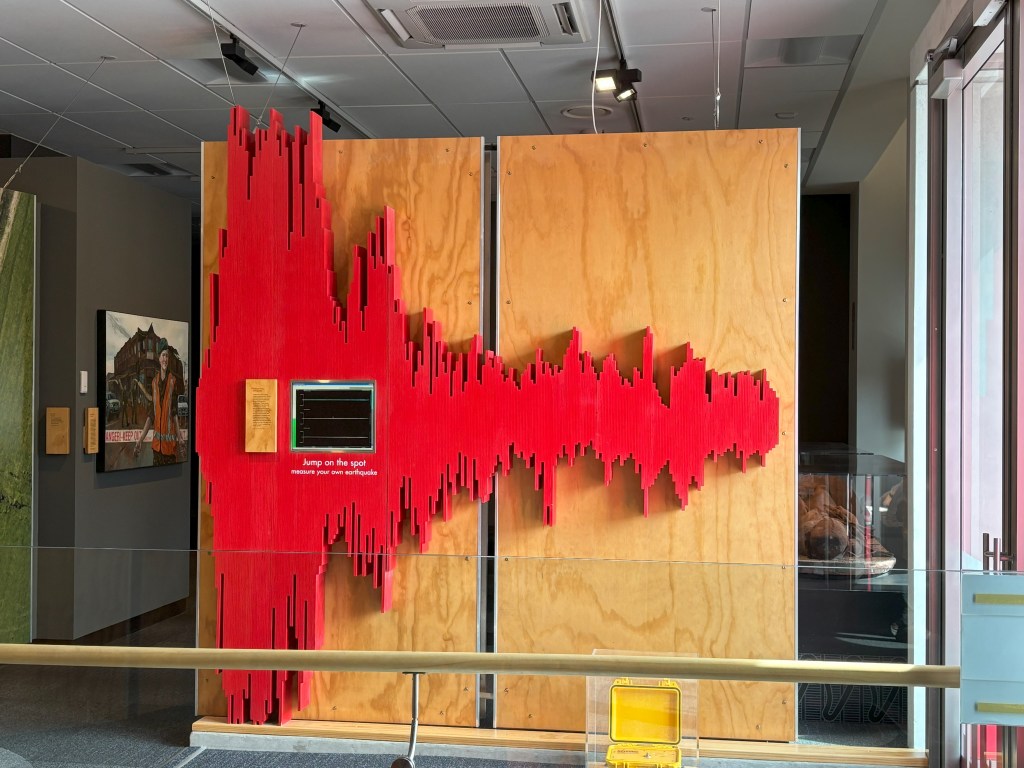
Now is when we entered a heavier subject. We learnt about the legend behind earthquakes, it’s time for the more recent events. There were a lot of emotions brought up considering I was alive when the Canterbury earthquakes took place. I didn’t really understand what was happening at the time, but I vaguely remember seeing the damage it had caused on the news. Along one of the museum walls displayed a timeline of different earthquakes in or near Christchurch, with quotes of people who experienced them. I remember thinking how sad it is that this timeline was so long. We also got to “measure our own earthquake” by jumping in front of a seismograph, a great way to teach kids how magnitude works.
Here’s where it got even more emotional. We watched the old news report from when the earthquakes had occurred, showing CCTV footage during the tremor and helicopter footage of the aftermath. We then walked around to the little cinema room to watch the short film “12.51”, which features interviews of different people who survived the 2011 Canterbury earthquake as well as some of the emergency workers who helped during the disaster. Listening to these people’s stories brought up so many emotions as a person who can be extremely empathetic in different situations. Everyone involved was affected in some way, either personally, physically or emotionally. One woman lost some of her fingers, nearly losing her whole hand, another guy suffered a spinal injury, many people lost family members and friends, and these were just the people featured in the interviews. 185 people died during the 2011 earthquake, many more were injured, and so many more were affected by losing someone close to them. I wouldn’t be wrong in saying experiencing an earthquake of this level would leave some amount of emotional trauma. So I can only imagine what these people went through.

After we had finished watching all the interviews, we moved on to see the damage that earthquakes can cause first-hand. Of course, no one will ever know how scary an earthquake of this magnitude can be besides those facing it themselves. But seeing different items that were salvaged from the Canterbury earthquakes put me in a place of physical and mental shock. I couldn’t take my eyes off this car door that had just been completely crushed. I can’t imagine seeing my home turned into a place of destruction. The spirit of these people must be so strong.
Here’s something I’ve never heard of before; liquefaction. I guess since where I come from we don’t usually have big earthquakes so the term has never really come up before. But liquefaction is the process of loose sediments like soil losing contact with one another when the ground vibrates, thus behaving like a liquid. Quake City had a liquefaction simulator with sand and different objects to display this process simply and make it a little easier for the kids, and me, to understand. As fun as it was to test this out, it’s kind of scary how the earth can behave this way during an earthquake. If you image search “liquefaction” you’ll find so many photos of cars and buildings being swallowed by the ground.
Quake City was probably the most emotional museum exhibit I’ve visited. But it’s definitely been one of my favourites. I learnt so much about earthquakes, Māori legends, Canterbury as a whole, and the strength of the human spirit. Although these 2 earthquakes were some of New Zealand’s biggest disasters, the exhibit highlights the importance of teamwork and survival. The earthquakes tore the region down, but these people have the resilience to build their home again, stronger and better than ever!
All photos in this post were taken by me.
For more information, visit https://quakecity.co.nz/

 The Travel Journal
Leave a comment